

AI-Ready Data Series — Part 3
In the previous article, we focused on one of the most important foundations of trustworthy AI: context.
Lukas Zimmermann’s session at our AI Success Starts with AI-Ready Data event showed why AI-ready data is not just about moving data into a modern platform or building another dashboard. AI systems need business meaning, governance, and consistency, which is exactly why semantic layers are becoming such a critical part of enterprise AI architecture.
But once organizations solve the context problem, another challenge quickly arises: can the infrastructure behind AI actually support enterprise-scale use?
In real business environments, AI is no longer just a chatbot or a proof of concept running on isolated datasets. It becomes part of operational systems, analytics processes, and decision-making workflows, often across large volumes of both structured and unstructured data.
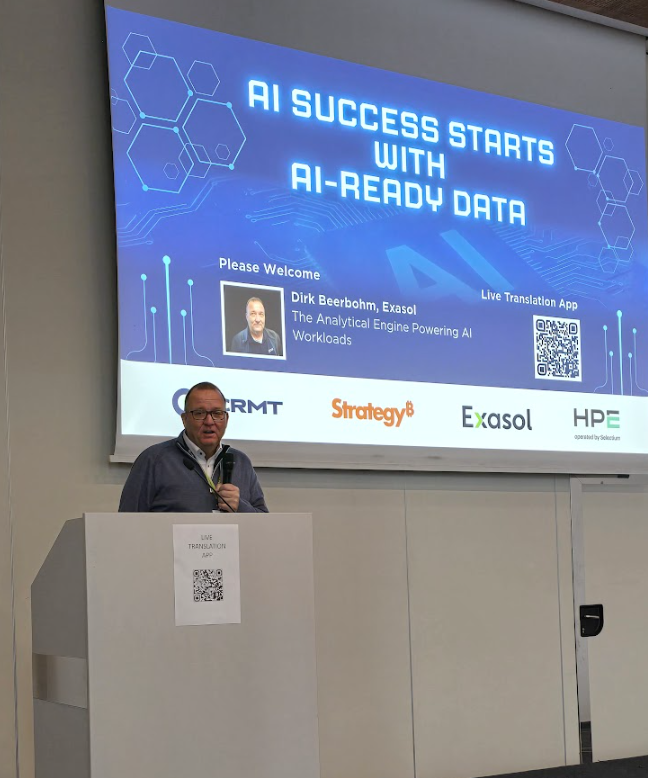
And that changes the requirements completely. One of the strongest messages from Dirk Beerbohm’s session (Exasol) at the same event was that successful enterprise AI depends on far more than the model itself. It depends on the infrastructure, governance, and data architecture supporting it.
AI-Ready Data Series
1: AI Success Starts With AI-Ready Data: What “Ready” Really Means
2: One Definition of Truth: Semantics as the Backbone of Trusted AI
3: The infrastructure challenge behind enterprise AI
The real AI challenge starts after the pilot phase
Most AI discussions today still focus on models, copilots, and prompts. But according to Beerbohm, the real complexity begins once organizations move from experimentation into production-scale AI usage.
Traditional analytics environments were built around structured data: ERP systems, CRM records, financial transactions, and reporting platforms.
These systems are predictable because the data is organized and governed. The problem is that most enterprise knowledge does not exist in structured tables.
Documents, emails, PDFs, operational notes, customer feedback, logs, and contracts represent a much larger portion of business information, and most of it remains inaccessible to traditional analytics approaches. Beerbohm described this as the “hidden” part of enterprise data: large volumes of unstructured information that organizations rarely use effectively.
AI changes this completely. Large language models enable the extraction of meaning, entities, sentiment, and context from unstructured information in ways that were previously too complex or too expensive to implement. But this also introduces entirely new operational requirements.
AI workloads are different from traditional analytics
One of the most important distinctions in the session was that AI workloads behave very differently from classical BI or reporting environments.
Traditional analytics systems primarily process structured queries and rely on predefined models.
AI systems, on the other hand, require:
- significantly more computing power,
- faster processing,
- scalable execution,
- and the ability to work with structured and unstructured data simultaneously.
Beerbohm explained that modern AI architectures increasingly aim to process AI workloads as close to the data as possible to avoid unnecessary data movement, reduce complexity, and improve performance.
This becomes especially important once AI moves beyond isolated pilots and starts supporting operational processes in real time.
In other words, AI is not just another application layer added to the existing infrastructure. It changes the architecture itself.
Governance becomes even more critical
As AI capabilities grow, so do governance challenges. One of the recurring themes of the event was that organizations must retain control over how AI accesses, interprets, and uses enterprise data.
This is particularly important in regulated industries such as banking, insurance, and telecommunications, where explainability, traceability, and compliance are non-negotiable requirements.
Large language models can generate highly convincing outputs, but organizations often cannot fully trace how those outputs were created. Beerbohm highlighted this as one of the major limitations of large language models in enterprise environments.
That is why AI should support decision-making, not autonomously execute decisions without governance and human oversight.
The conversation therefore shifts from: “Can we use AI?” to: “Can we govern AI responsibly at scale?”
And that question is as much about infrastructure as it is about data.
Why sovereignty and deployment models matter again
Another major theme was sovereignty. Over the last decade, many organizations adopted cloud-first strategies. But AI workloads are forcing companies to reevaluate where data should reside and where processing should happen.
Beerbohm presented architectures in which AI processing occurs directly within controlled environments, without sensitive metadata or schema information leaving the organization’s infrastructure.
This approach addresses several growing concerns:
- data sovereignty,
- governance,
- latency,
- operational control,
- and predictable performance.
For many organizations, especially those operating in regulated sectors, hybrid and on-premise AI environments are becoming increasingly important parts of enterprise architecture.
The goal is no longer simply “cloud-first.” The goal is to place workloads where they make the most operational and regulatory sense.
AI-ready means infrastructure-ready
The first two articles in this series focused on trust, semantics, and business context. But AI readiness does not stop at the data layer.
Enterprise AI also requires:
- scalable infrastructure,
- governed execution environments,
- secure access models,
- support for unstructured data,
- and architectures capable of reliably handling modern AI workloads.
The organizations that succeed with AI will not necessarily be the ones experimenting with the largest models.
They will be the ones building the strongest foundations behind them.
Read more
Exasol Shines in Latest Data Management Survey by BARC
In the rapidly evolving world of data management, Exasol has once again proven itself to be a beacon of innovation and reliability. According to The Data Manage...
Read moreAI Success Starts With AI-Ready Data: What “Ready” Really Means
AI-Ready Data Series — Part 1 AI is everywhere right now. New copilots, assistants, agents, and automation promises appear almost weekly. But in practice, man...
Read more