

Imagine the following scenario: your finance department reports revenue that is 10% higher than the sales team’s figures. Meanwhile, executive management receives a third and fourth version of the exact same key metric from two different AI agents. Sounds familiar?
In an era when companies are scrambling to implement artificial intelligence as quickly as possible, a fundamental truth is often overlooked: AI is only as smart as the organized, consistent data that feeds its models.
In this post, we address key questions about the future of data management and the role of modern solutions like Strategy Mosaic.
1. Do universal semantic layers even stand a chance of success in this era of rapid AI development?
The short answer: Not only do they stand a chance, but they are also becoming critical infrastructure for survival!
The semantic layer market is projected to be among the fastest-growing segments in data intelligence between 2025 and 2031, with a forecasted annual growth rate of 30%. This explosion is driven precisely by the advancements in artificial intelligence.
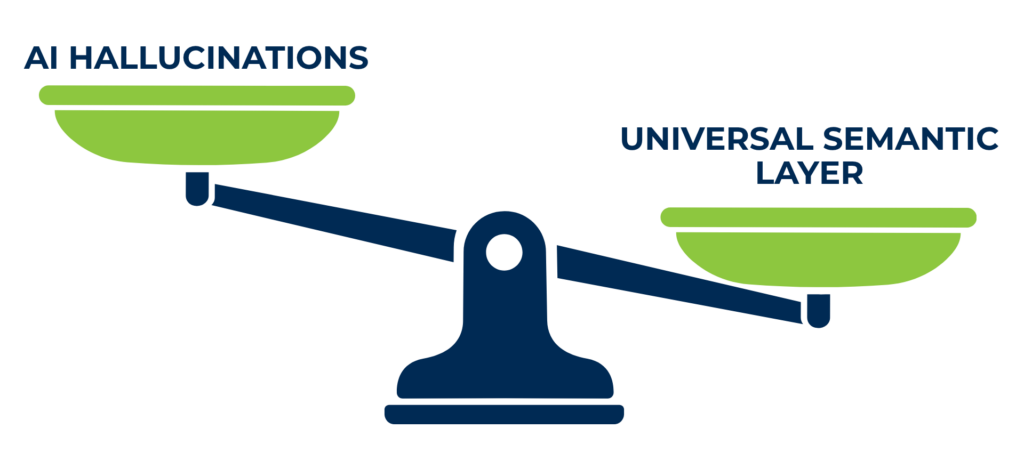
Without a universal semantic layer, advanced AI agents:
- Hallucinate metrics and provide inconsistent answers.
- Lack a proper audit trail (making it practically impossible to determine how they arrived at a final result).
- Operate in silos, which spells the end of a single source of truth.
2. Universal Semantic Layer vs. Self-Directing AI: The Reality of Both Approaches
We are currently witnessing a duel between two fundamentally different approaches in the market. Let’s look at the reality of both worlds.
Approach A: Decentralized, automatically generated semantic layer based on AI
This is a concept in which an AI agent either reads raw data, infers relationships, and builds a temporary knowledge graph, or executes queries using RAG/LLM. While it sounds appealing, in practice, it quickly hits the following brick walls:
- Security risks: An AI that discovers data on its own requires extremely broad permissions and is a recipe for data leaks and overexposure. Mosaic, on the other hand, federates data and enforces access control at the semantic layer.
- Lack of business context understanding: AI does not inherently know business logic. The term “revenue” in finance does not mean the same thing as “revenue” in marketing. AI will pick the statistically most likely definition, overlooking nuances such as deferred revenue or currency differences. Consequently, finance will report 10% higher revenue than sales, and the CEO will receive conflicting numbers from different AI agents.
- Inevitable hallucinations: LLM models are probabilistic by nature. Without clearly defined metrics, hierarchies, transformations, and row-level security, AI will have to guess at joins, filtering, and calculations. Asking the same question (“What is our NPS by region?”) in three different chats could yield three completely different values.
- Absence of Data Governance: Who owns the definition? What happens when regulations change (e.g., ESG, GDPR, SOX)? Who performs the audit? AI cannot take responsibility. In regulated industries (banking, pharma, public sector), this is an immediate dealbreaker.
The Breaking Point: This approach might work satisfactorily for a few months in a small company or a startup with a single team. The moment you cross the threshold of 50 metrics or multiple teams, the system inevitably collapses.
Approach B: Governed and centralized hybrid semantic layer (e.g., Strategy Mosaic)
This approach combines human oversight over business logic with AI acting as an accelerator. Of course, this approach also has its challenges if not executed correctly:
- The Bottleneck Risk: If data teams build the layer in silos without business alignment, the solution can become costly and struggle to adapt quickly.
- Requires Organizational Maturity: Without a strong data culture, an advanced tool will serve as nothing more than a “glorified dashboard” rather than becoming the operational foundation for AI.
- AI Assists, but Humans Decide: The AI within Mosaic excels at AI-assisted data modeling and semantic tagging, but final validation and business logic configuration must still be driven by humans. Skipping this human validation leads to the exact same pitfalls found in Approach A.
Overview: Which approach actually works in an enterprise environment?
| Aspect | Pure AI Self-Built Semantic Layer | Governed Semantic Layer (Strategy Mosaic) | Winner in Practice |
| Consistency of Metrics | Poor (conflicting answers) | Excellent (single source of truth) | Strategy Mosaic |
| Governance & Auditing | Virtually non-existent | Built-in (security, hierarchies) | Strategy Mosaic |
| Speed of Implementing Changes | Very fast (prompting) | Fast (AI-assisted + centralized) | Strategy Mosaic (Hybrid) |
| Compliance Risks | High | Low | Strategy Mosaic |
| Long-term Costs | Low initially, skyrocketing later | Higher initially, lower long-term | Strategy Mosaic |
| AI Agent Capabilities | Hallucinates without context | High and reliable | Strategy Mosaic |
3. What is the best approach moving forward?
The best strategy is not “either AI or a semantic layer,” but rather a hybrid model: Mosaic as the foundation and AI as the accelerator.
This stance is not anti-AI. On the contrary, it is the only true pro-AI approach that recognizes the real limitations of large language models. The artificial intelligence within the Strategy Mosaic ecosystem assists with rapid modeling (e.g., defining metrics using natural language), while governance, security, and final outputs remain under human control.
Conclusion
A pure AI that “builds its own semantic layer” makes for an attractive demo at tech conferences, but in real business, it is a recipe for chaos, poor decisions, and regulatory fines.
Modern universal semantic layers, like Strategy Mosaic, solve exactly what AI cannot do on its own. They don’t move or copy data; instead, they virtualize it across various sources (Snowflake, Databricks, BigQuery…) and serve strictly governed, accurate metrics to AI agents via interfaces like MCP, Python, and REST.
The trend is clear. The semantic layer is the new critical infrastructure of the AI era. Without it, you will continue to get incredibly fast—yet entirely wrong—answers.
About the Company and the Strategy Mosaic Solution
Strategy Mosaic is a modern, AI-ready semantic layer (Universal Intelligence Layer) developed by Strategy. Unlike traditional semantic layers from the 1990s business intelligence era, Mosaic operates as a federated enterprise solution that connects modern data sources without data duplication, ensuring that all your AI agents speak the same business language.
Let’s keep the conversation going! Are your AI agents already using a unified semantic layer, or is your company still reconciling different interpretations of the same metrics?
If you are interested in how Strategy Mosaic could be integrated into your data ecosystem, or if you simply have additional questions about the future of semantic layers, please reach out to us. We would be happy to discuss your challenges and help you find the right solutions.
Read more
GenAI Without Data Governance is Exposure: The Universal Semantic Layer
From Data Chaos to Trusted Intelligence There is no modern business without data. However, without shared meaning and governance, it’s an unstable asset. Ever...
Read moreThe Universal Semantic Layer – The Key to Data Security and Usage Compliance
For organizations aiming to master a data-intensive world In an era where artificial intelligence (AI) and its agents are becoming critical to business success,...
Read more