

How continuous planning, connected data, scenario analysis, and AI are transforming financial planning and analysis.
For many finance teams, budgeting and forecasting still follow a familiar routine: prepare an annual budget, update forecasts periodically, analyze variances and report the results. While these activities remain essential, they are no longer sufficient to support business decisions in an increasingly unpredictable environment.
Market conditions change, costs fluctuate, and new risks emerge long before the next planning cycle begins. Finance leaders are therefore expected to do more than explain past performance. They need to anticipate developments, evaluate potential outcomes and help businesses respond with confidence.
This is where modern Financial Planning & Analysis (FP&A) comes in.
Modern FP&A represents a shift from periodic financial planning and historical reporting towards continuous, forward-looking decision support. By connecting financial and operational data, forecasting, scenario analysis and AI-assisted insights, organizations can develop a more responsive approach to financial management.
Why traditional FP&A is no longer enough
Traditional financial planning provides structure, financial discipline and accountability. Annual budgets establish targets, allocate resources and communicate business priorities. Periodic forecasts and variance analyses help organizations monitor performance against expectations.
However, these processes can become less effective when business conditions change faster than the planning calendar.
A budget approved before the start of the financial year may rely on assumptions that are no longer relevant just a few months later. Changes in customer demand, pricing, production costs, interest rates or supply conditions can materially affect financial performance.
Yet many organizations continue to evaluate their results primarily against the original budget, without maintaining an equally reliable view of what is now likely to happen.
Modern FP&A addresses this challenge by distinguishing between two essential perspectives:
Financial targets define what an organization intends to achieve.
Financial forecasts reflect what the organization currently expects to achieve, based on the latest available information and assumptions.
Keeping these perspectives separate allows Finance to identify emerging gaps earlier and help management determine whether corrective action is needed.
The objective is not to eliminate annual budgeting, but to ensure that financial planning remains relevant as circumstances evolve.
Continuous planning: Keeping forecasts aligned with business reality
One of the most important developments in modern FP&A is the transition from fixed planning cycles towards continuous planning.
Rather than updating forecasts exclusively according to a predefined calendar, organizations can revise assumptions when significant business developments occur.
A change in sales demand, supplier prices, workforce requirements or production capacity may justify reassessing the financial outlook before the next scheduled forecasting cycle.
Rolling forecasts support this approach by maintaining a consistent forward-looking horizon instead of limiting visibility to the end of the current financial year.
However, continuous planning does not mean constantly revising every forecast or changing financial targets whenever circumstances shift.
Effective continuous planning requires clear responsibilities, defined business drivers, appropriate review cycles and governance controls.
Finance teams need to determine which developments are significant enough to trigger a forecast update and which assumptions can remain unchanged.
This creates a more responsive planning process without introducing unnecessary complexity.
Connecting financial and operational planning
Financial performance is shaped by decisions made throughout the organization.
Sales volumes and pricing influence revenue. Workforce decisions affect personnel costs. Production efficiency has a direct impact on margins. Procurement conditions, inventory levels and investment decisions influence profitability and cash flow.
Despite these connections, financial and operational planning are frequently managed through separate processes, systems and spreadsheets.
This creates additional work for Finance, particularly when departmental assumptions need to be consolidated, validated and translated into a consistent financial outlook.
Integrated business planning addresses this challenge by connecting financial and operational assumptions within a common planning framework.
Instead of preparing isolated departmental plans, Finance can collaborate more closely with Sales, Operations, HR, Procurement and other business functions.
Consider a manufacturing company planning to increase production to meet expected demand.
The decision affects more than projected revenue. It may require additional employees, higher material purchases, increased capacity, and changes in working capital.
An integrated planning approach makes it possible to assess these relationships together and understand their combined financial implications.
By connecting operational activities with financial outcomes, Finance can provide management with a more complete picture of business performance and the consequences of proposed decisions.
Driver-based planning: Understanding what influences performance
Traditional budgeting often focuses on financial accounts and historical expenditure. While this information is essential, it does not always explain why financial performance changes.
Driver-based planning focuses on the operational and financial factors that have the greatest influence on business results.
For a manufacturing company, these might include production volumes, capacity utilization, raw material prices and labor costs.
For a service organization, relevant drivers may include billable hours, utilization rates, staffing capacity, customer demand and pricing.
By linking financial projections to these underlying drivers, organizations can develop forecasts that are easier to understand, explain and update.
For example, rather than manually adjusting multiple financial accounts when sales expectations change, Finance can evaluate how revised sales volumes affect revenue, production requirements, costs and profitability.
This approach also supports more meaningful management discussions.
Instead of simply reporting that operating profit is below budget, Finance can identify the factors driving the shortfall and assess which actions could improve future performance.
Driver-based planning therefore strengthens both forecasting and Finance’s role in supporting business decisions.
Scenario analysis: Preparing for more than one possible future
A financial forecast reflects a set of assumptions about what is likely to happen.
But business decisions rarely take place in an environment where only one outcome is possible.
Changes in market demand, operating costs, supply conditions, or financing requirements can lead to different financial outcomes, each requiring a different response.
Scenario analysis enables organizations to evaluate these possibilities before decisions become urgent.
A typical approach includes a baseline scenario reflecting current expectations, an upside scenario exploring potential opportunities and a downside scenario assessing relevant risks.
Stress testing can extend this analysis to more severe but plausible developments.
Consider an organisation facing uncertain demand and increasing input costs.
Management may want to understand how different combinations of sales volumes, pricing adjustments and cost increases could affect operating margins and liquidity.
By modeling these scenarios, Finance can help compare potential outcomes, identify relevant risks and evaluate available responses.
The purpose of scenario analysis is not to predict the future perfectly. It helps organizations make better decisions under uncertainty.
When scenario analysis is connected to operational drivers and reliable financial information, assumptions can be changed more consistently and their implications assessed across the organization.
How AI is changing financial planning and analysis
Artificial intelligence is expanding the analytical capabilities available to finance teams.
According to Wolters Kluwer’s 2026 Future Ready CFO Report, 62% of surveyed senior finance leaders expect AI and advanced analytics to have a major or transformational impact on budgeting, forecasting and performance analysis over the next three years.
This reflects growing interest in applying AI to practical financial management challenges.
AI-assisted capabilities can support various activities within FP&A, including:
- Predictive forecasting: Analyzing historical, financial, and operational data to identify patterns that may inform future projections.
- Anomaly detection: Identifying unusual movements, inconsistencies or potential risks in financial and operational information.
- Driver analysis: Helping finance teams identify and evaluate the factors influencing financial performance.
- Variance analysis: Supporting the identification and explanation of differences between actual results, budgets and forecasts.
- Scenario analysis: Accelerating the evaluation and comparison of alternative business assumptions.
These capabilities can reduce repetitive analytical work and enable finance professionals to devote more attention to interpreting results and supporting management decisions.
However, AI adoption in Finance also raises important questions about data quality, transparency and accountability.
Financial forecasts and recommendations must be understandable, traceable and supported by reliable information.
AI-generated outputs also need appropriate human review, particularly when they influence material business decisions.
Finance professionals remain responsible for validating assumptions, interpreting results and determining whether the conclusions are appropriate for their organization.
AI can accelerate analysis and highlight possible courses of action, but financial expertise and human oversight remain essential.
Modern FP&A is also transforming the role of Finance
The evolution of FP&A involves more than introducing new technology or improving forecasting methods.
It also changes how finance professionals contribute to business management.
When significant resources are devoted to collecting data, reconciling spreadsheets and preparing recurring reports, Finance may have limited capacity for forward-looking analysis.
More connected and automated processes can help reduce these activities, creating opportunities for finance teams to focus on business interpretation, scenario evaluation and strategic support.
This changes the questions Finance can help management answer.
Instead of concentrating primarily on what happened and why actual results differed from the budget, Finance can increasingly focus on what is likely to happen, which factors matter most, and what actions are available.
The transition requires appropriate technology, reliable data, consistent processes, clear responsibilities, and closer cooperation with business functions.
Organizations do not need to transform every aspect of FP&A at once.
Modernization can begin with improving data consistency and connecting actual results with planning processes. It can then progress towards driver-based forecasting, integrated business planning, scenario analysis and targeted AI applications.
The priority should be to address the processes and limitations that have the greatest impact on the organization’s ability to make informed decisions.
Supporting modern FP&A with CCH Tagetik
Moving towards continuous, integrated planning requires a technology environment capable of connecting financial and operational information, planning processes and analytical capabilities.
CCH Tagetik, the corporate performance management platform from Wolters Kluwer, supports organizations in managing budgeting, financial and operational planning, forecasting and scenario analysis within a governed environment.
The platform connects plans, forecasts and actual results on a common foundation, helping finance teams work with more consistent information across financial processes.
Its planning capabilities support rolling forecasts, driver-based models and scenario analysis, enabling organizations to assess how changes in business assumptions may affect financial performance.
CCH Tagetik also supports integrated business planning, connecting financial planning with operational areas such as supply chain, production and workforce planning.
In addition, the platform incorporates CCH Tagetik Expert AI, which brings AI-assisted capabilities into financial processes.
These include predictive forecasting, anomaly detection and analytical support designed to help finance teams identify relevant developments and understand financial outcomes.
The emphasis on explainability, governance and human oversight is particularly important for organizations seeking to introduce AI into financial decision-making.
However, adopting a modern FP&A platform is only part of the transformation.
The effectiveness of the solution also depends on how well it is implemented, integrated with existing systems and aligned with an organization’s financial and operational requirements.
CRMT: Your CCH Tagetik Platinum Partner in Slovenia and the CEE region
CRMT is a CCH Tagetik Platinum Partner for Slovenia and the wider Central and Eastern European (CEE) region, with extensive experience in implementing and optimizing corporate performance management solutions.
As a regional Wolters Kluwer sales and implementation partner since 2008, we help organizations translate the capabilities of CCH Tagetik into financial processes that support their business requirements.
Our expertise covers financial planning and forecasting, financial consolidation, reporting and broader corporate performance management processes.
We support customers throughout the implementation lifecycle, from analyzing requirements and designing solutions to system integration, implementation, training and ongoing optimization.
By combining financial process expertise with technical implementation capabilities, we help organizations establish reliable, connected and more responsive financial management environments.
CRMT’s Platinum Partner status is also recognized in the official Wolters Kluwer CCH Tagetik Partner Directory.
From better forecasts to better business decisions
Modern FP&A is not simply about producing forecasts faster, automating reporting or introducing new technologies.
It is about helping organizations understand changing conditions, evaluate their implications and make informed decisions.
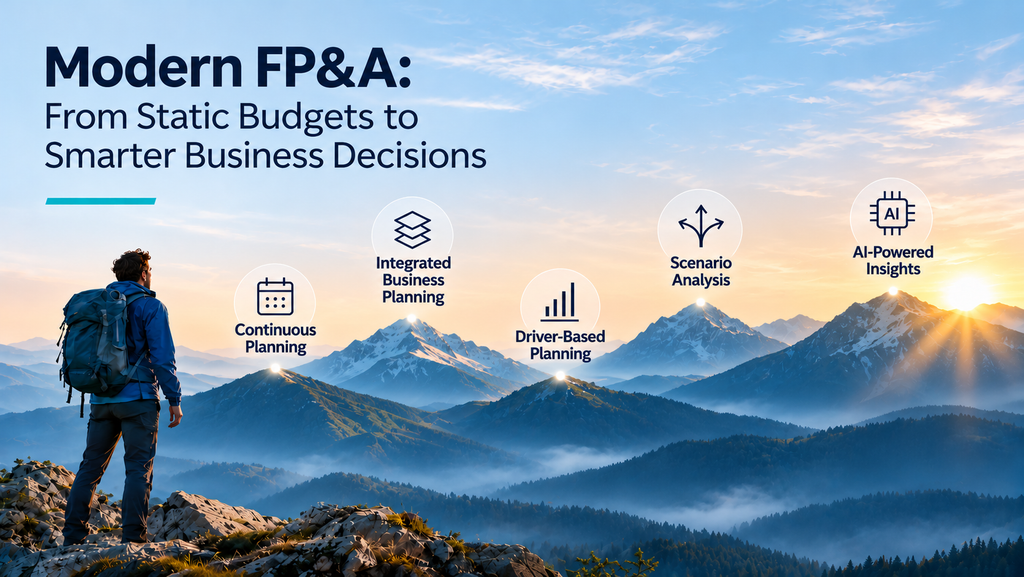
Continuous planning keeps financial outlooks relevant. Integrated business planning connects financial results with operational reality. Driver-based forecasting explains the factors influencing performance, while scenario analysis helps organizations prepare for uncertainty.
AI-assisted capabilities can further strengthen these processes by accelerating analysis and identifying developments that deserve attention.
Together, these capabilities enable Finance to move beyond historical reporting and take a more proactive role in supporting business performance.
Ready to modernize your FP&A processes?
At CRMT, we help organizations implement and optimize CCH Tagetik solutions to support connected financial planning, forecasting, analysis and decision-making.
Contact our team to discuss your financial planning challenges and explore how CCH Tagetik can support your organization.
Further reading
This article builds on key themes discussed in The Modern FP&A Playbook by Marco Vigolo, Director, FP&A and Operational Planning at Wolters Kluwer.
The original article explores the evolution of modern FP&A, continuous planning, scenario analysis, and the role of explainable AI in financial decision-making.
Read more
AI in CPM: Is Your Finance Team Spending Time on Data or Decisions?
Artificial intelligence has officially evolved from a futuristic talking point into an active, conversational partner within modern finance architecture. Yet in...
Read moreWhy Leading Companies Trust CCH Tagetik for Consolidation and Performance Management
In an era where finance leaders are expected to deliver speed, accuracy, and strategic insight, CCH Tagetik stands out as the intelligent platform that unifies ...
Read more