

CRMT was a proud sponsor of Global CCH® Tagetik inTouch 2026, held in Lucca, Italy, from 19 to 21 May. Our own Daniel Potočnik attended the event alongside more than 750 corporate finance leaders, partners, and product experts gathered to examine the evolving Office of the CFO.
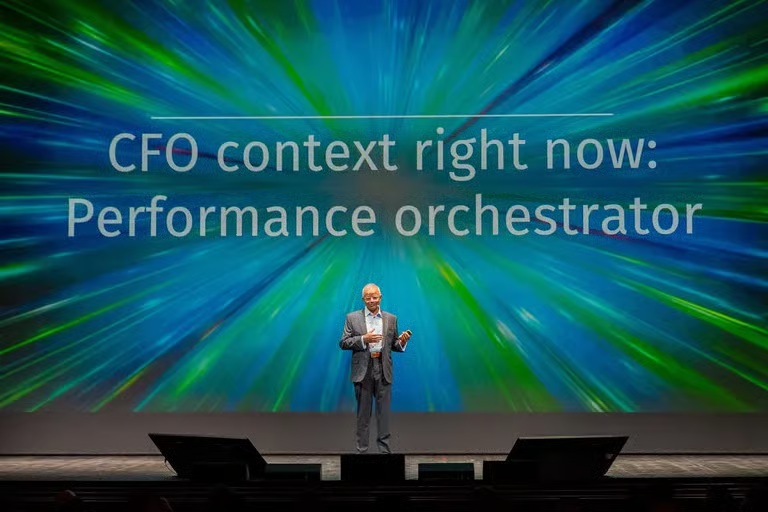
The event established a clear direction for the finance function: the transition from isolated digitization to performance orchestration. As AI becomes embedded in core operations and expectations in finance continue to rise, the ability to link financial results to operational drivers in real time has become a defining capability. For the Office of the CFO, this means acting as a performance orchestrator, translating complex operational activity into clear, accountable decisions.
Among the keynote speakers was Atul Dubey, Executive Vice President and General Manager of CCH® Tagetik, who presented his vision for the evolving role of the CFO as a performance orchestrator, a theme that shaped discussions throughout the event
Trust as the Prerequisite for Autonomous Finance
The finance function is not short on data. What has changed is the complexity of the environment and the need to orchestrate that data across the enterprise in a way that can be trusted. While the vision of autonomous finance is compelling, the current reality remains fragmented. Polling conducted during the event revealed that 58% of respondents reported that their systems remain manual or siloed, limiting their ability to respond to market shifts. Critically, 47% of respondents cited trusted data as a prerequisite for adopting autonomous agents, underscoring that governance and auditability are not secondary concerns, but the foundation on which transformation depends.
Human judgment remains central to these outcomes: polling showed teams most often lead or hold primary responsibility for accounting and financial close (72%) and cash flow and liquidity oversight (61%). When planning, closing, and reporting environments are only partially aligned, visibility drops, execution slows, and accountability becomes harder to maintain.
Embedding Intelligence into Existing Workflows
The focus has shifted from treating AI as a separate tool to embedding capabilities directly into planning, reporting, and performance management workflows. Expert AI analyzes data to support forecasting and reporting, providing a grounded starting point for human analysis within the processes teams already own. Planning Sentinel detects changes, risks, and outliers across planning environments before they become systemic issues, functioning not as a standalone product, but as an embedded layer within CCH® Tagetik’s broader performance management ecosystem. The objective is an environment where outputs are trusted, assumptions are visible, and decisions remain grounded in governed data.
CRMT: Bringing CCH® Tagetik to Life in Your Organization
At CRMT, we work with finance teams to translate the capabilities presented in inTouch into working implementations. As a CCH® Tagetik Platinum implementation partner, our role is practical: designing planning models, configuring workflows, and connecting the platform to the data sources your organization already relies on. The quality of that implementation work directly determines whether capabilities such as Expert AI and Planning Sentinel operate on data that is consistent, current, and meaningful to your team.
Moving from fragmented reporting to a connected performance management model within CCH® Tagetik is achievable, but it requires getting the foundational configuration right. That means aligning planning structures with how your business actually operates, ensuring data flows correctly between systems, and building workflows that finance teams will use consistently. If you are considering a CCH® Tagetik implementation or looking to improve an existing one, we would be happy to discuss where to start. Get in touch with our team of experts.
CCH® Tagetik inTouch 2026 Highlights
Read more
Agentic AI on the Rise: What Finance Leaders Need to Know
Finance functions are entering a new era, with agentic AI gaining serious traction. At the recent CCH Tagetik inTouch25 conference, a survey of 392 finance lead...
Read moreCCH® Tagetik Global inTouch 2026: Showcasing Expert AI for the CFO
The transition from reactive reporting to proactive orchestration requires more than new features: it requires a governed data foundation. Wolters Kluwer has an...
Read more