

Insights from the Adriatic Controlling Conference
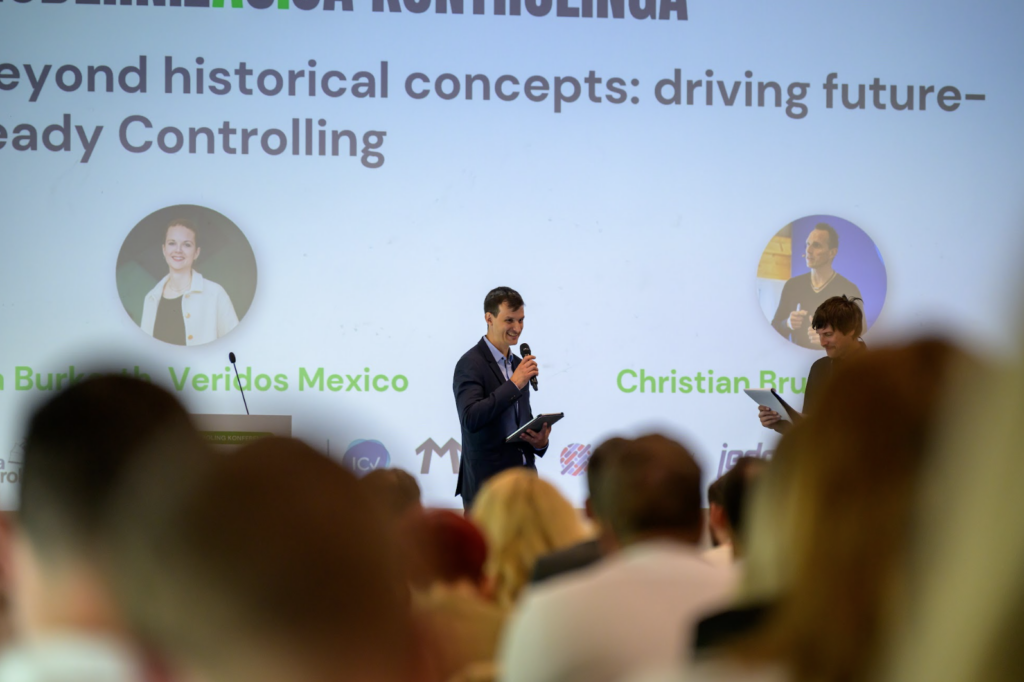
We continue our blog series highlighting the standout sessions from this year’s Adriatic Controlling Conference with Beyond Historical Concepts: Driving Future-Ready Controlling, presented at the 21st Adriatic Controlling Conference (26 May, Hotel Mons, Ljubljana) by Christian Brumm, Head of Finance Operations Excellence at Zalando and co-author of Agile Konzepte im Controlling, and Pia Burkarth, Finance Director at Veridos Mexico and board member of the International Association of Controllers (ICV).
The two speakers set out to answer a deceptively simple question: what leadership principles and structures does controlling actually need today to create real value for the business, and how can a function built for decades on planning and analysis make the leap into a world defined by constant change?
Insights from the Adriatic Controlling Conference
1: From Reactive Reporting to Proactive Controlling: Lessons from Zavarovalnica Sava
2: When Dashboards Replace Guesswork: Resalta’s Journey to Real-Time Operational Controlling
3: Beyond Historical Concepts: Building a Future-Ready Controlling Function
The BANI world: beyond uncertainty into incomprehensibility
The talk opened with a simple observation: businesses today no longer operate only in the familiar VUCA environment (volatile, uncertain, complex, ambiguous). Increasingly, they find themselves in what has been termed a BANI world (brittle, anxious, nonlinear, incomprehensible). According to the speakers, global value chains, political instability, technological disruption such as artificial intelligence, and rapidly shifting market conditions are all forcing controlling to rethink how it leads and how it makes decisions, compared with the more predictable business environment of the past.
From complicated to complex: the Cynefin framework
To explain when agile methods are appropriate and when traditional ones still hold up, the speakers introduced the Cynefin framework, which sorts business challenges into four categories: simple, complicated, complex, and chaotic. In both simple and complex situations, where cause and effect are relatively clear, established, traditional planning methods still work well. In complex and chaotic environments, however, where the link between actions and outcomes is not known in advance, a different approach is required: experimentation, continuous learning, self-organizing teams, and leadership that supports the team rather than simply controlling it.
As the speakers put it, this amounts to a genuine paradigm shift: from a world in which organizations were built on planning, knowledge and facts, to one shaped by experimentation, learning, and empowered teams.
Mindset as the link between purpose and tactics
One of the more thought-provoking parts of the talk centered on a model in which mindset, meaning the beliefs, values and principles that guide a team, is what connects purpose (the shared goals and direction) with tactics (processes, tools, roles, meetings). Without alignment between why we do something and how we do it, the speakers argued, an agile transformation simply cannot last. They were also clear that there is no one-size-fits-all answer: every organization and team needs to adapt its own processes, roles and tools to its specific circumstances.
Closely related is the concept of a growth mindset, drawing on the work of psychologist Carol Dweck: people with a growth mindset treat challenges as opportunities, persist through setbacks, learn from criticism, and draw inspiration from other people’s success rather than feeling threatened by it. According to the speakers, it is precisely these people who drive organizational transformation.
Agile leadership as the foundation for transformation
Burkarth pointed out that as the environment grows more complex, the role of the leader has to change with it. An agile leader’s main job is to set a clear direction and purpose, a kind of “North Star”, to guide the team toward self-organization, to trust decisions to the people who actually hold the relevant knowledge, and to delegate responsibility based on each person’s motivation and skill level. At the same time, leaders still need to strike a balance between genuine care for their people and the decisiveness the business requires, since deadlines and commercial expectations don’t disappear simply because a team becomes more agile.
Zalando in practice: controlling as “co-pilot”
In the second part of the talk, Brumm walked through how Zalando’s finance function evolved toward genuine business partnership. Rather than settling for the generic label “business partner”, the team at Zalando chose the metaphor of the co-pilot: someone who doesn’t fly the plane on behalf of the business, but who offers additional data, flags different scenarios, and helps shape the direction, all while knowing both the “aircraft” and the “pilot”, that is, the company and its people, inside out.
Living up to that role, Brumm explained, took a real investment in understanding the actual drivers behind the business, not just producing standard financial metrics. He illustrated the point with the image of an iceberg: a surface-level view of the customer and their needs is only the tip; genuinely understanding the business means diving into the underlying processes and data hidden beneath the waterline.
Among the concrete steps Zalando took, he highlighted:
- investing in a deeper understanding of data models and technology, including the use of AI tools, rather than simply bolting on new systems;
- defining strategic priorities that cut across individual functions, paired with closer communication between finance and the business;
- working through smaller, measurable milestones, essentially minimum viable products (MVPs), instead of waiting to deliver one finished solution;
- fostering internal collaboration the team came to call “swarm intelligence”: individual teams don’t need to know every detail of every other function, but they do need to be willing to engage with questions openly, starting from “yes” rather than reflexively pushing back.
Brumm also shared a candid moment from a conversation with the company’s co-CEO, who told the finance function bluntly that it needed to get its own house in order before it could expect a seat at the table for major business decisions. Uncomfortable as it was, he said, that moment became an important reminder that controlling has to earn its credibility with the business first, by getting its own data and processes right.
Closing thought: change as the only constant
The session closed with a line from the ancient philosopher Heraclitus: that change is the one constant we all have to learn to live with. Burkarth had opened the session by tying that idea to a broader question: how controlling can put itself in the customer’s shoes, deliberately leaving “customer” undefined, since this was meant as a general agile principle rather than a precisely scoped category. Brumm, by contrast, turned that same idea inward by the end of his talk and made it concrete: in his view, genuine business partnership in controlling comes down to treating internal business functions as customers in their own right, not merely as recipients of reports.
This post is part of our Insights from the Adriatic Controlling Conference series, in which we revisit selected sessions from this year’s event. The content reflects the views and experiences shared by the speakers at the conference.
Read more
When Dashboards Replace Guesswork: Resalta's Journey to Real-Time Operational Controlling
Insights from the 21st Adriatik Controlling Conference How do you manage a portfolio of 229 active projects across seven countries, spanning two distinct busine...
Read moreFrom Reactive Reporting to Proactive Controlling: Lessons from Zavarovalnica Sava
Insights from the 21st Adriatik Controlling Conference At this year’s 21st Adriatik Controlling Conference, dedicated to the modernization of controlling,...
Read more