

In today’s complex financial landscape, data is no longer just a byproduct of business operations. It is a strategic asset that demands rigorous management. With extensive experience in the banking sector, ranging from analytical system implementation to regulatory reporting, CRMT provides end-to-end support in establishing robust Data Governance frameworks.
Why Partner with CRMT?
The banking sector requires niche expertise and proven methodologies. Our approach is built on three core pillars:
- Deep Banking Domain Expertise: We understand the intricacies of regulatory mandates, analytical architecture, and DG compliance requirements.
- Pragmatic Approach: We start with your current state, focusing on delivering measurable results and defensible actions rather than just theory.
- Technology Neutrality: We provide independent evaluations to help you select tools that best fit your specific needs and target architecture.
Our Key Services for Banking Sector
1. BCBS-239 Compliance Advisory
Adherence to the 14 principles of BCBS-239 is vital for effective risk data aggregation and risk reporting.
Our services include:
- Compliance Assessment: A thorough review of all 14 principles to identify your current standing.
- Control Framework: Defining key controls across the entire data lifecycle (ingestion, transformation, reporting) and testing their effectiveness.
- DQ Metrics & Audit Support: Defining Data Quality metrics and providing hands-on support for addressing audit findings by preparing evidence-based remediation trails.
- Objective: Achieving structured, demonstrable compliance (Principles – Controls – Evidence) and significant risk reduction.
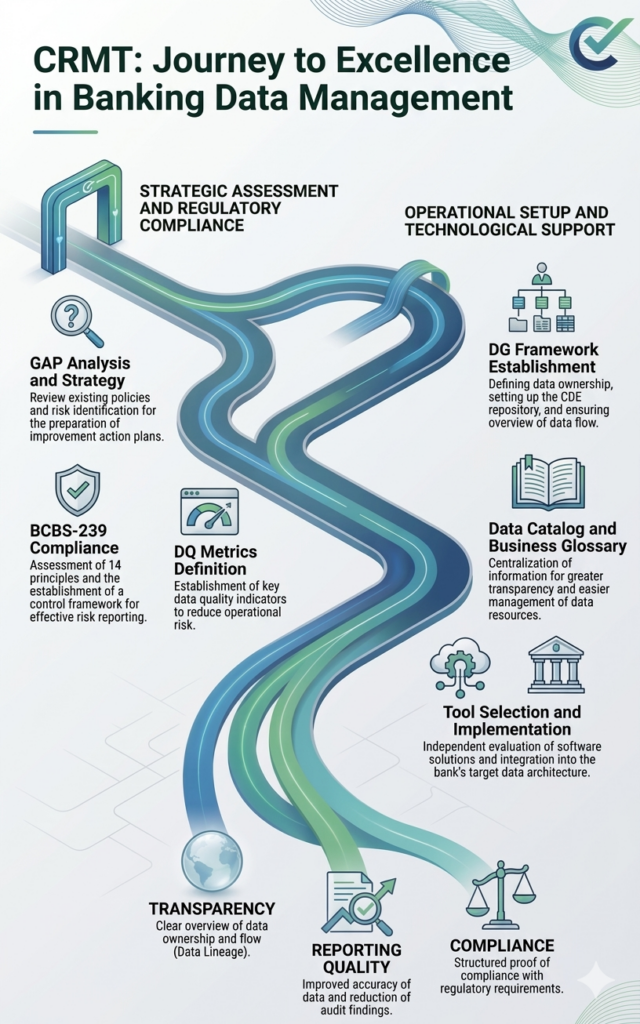
2. Strategy Assessment & GAP Analysis
Before implementing improvements, it is essential to understand the “as-is” state. Our team performs:
- Policy Analysis: Reviewing existing DG strategies, standards, and procedures for feasibility and clear accountability.
- Maturity Assessment: Evaluating the current maturity level of Data Governance within your organisation.
- Risk Identification: Pinpointing process gaps and identifying key risks relative to regulatory expectations.
- Roadmap: Developing a prioritised action plan to close gaps with a clear focus on operationalising requirements into daily business routines.
3. Establishing and Strengthening the DG Framework
Za dolgoročno uspešno upravljanje podatkov vzpostavimo procese, ki zagotavljajo preglednost in kontrolo:
- Roles & Responsibilities: Defining and implementing a formal Data Ownership model.
- Critical Data Elements (CDE): Establishing a repository for CDEs to streamline reporting and oversight.
- Business Glossary: Introducing a unified business glossary to align terminology and create a shared understanding of data across business and technical teams.
- Data Catalog: Implementing a centralised repository and inventory of metadata to improve transparency, simplify information discovery, and support easier access to relevant data assets.
- Data Lineage: Providing full end-to-end visibility into data flows and transformations, from source systems to final reports, to strengthen trust, traceability, and control.
- Data Quality: Setting up a comprehensive Data Quality framework, including defined rules, KPIs, and escalation paths, to enable continuous monitoring and improvement of data quality.
4. Support for DG Tool Implementation
Technical installation is only a small part of the success; the focus must be on process integration. We provide:
- Tool Selection: Independent evaluation of tools for cataloguing, DQ, and lineage based on your architectural requirements.
- Architecture & Integration: Defining the target data architecture and integration models with existing systems.
- Pilot Phase & Knowledge Transfer: Leading configuration and pilot runs while ensuring your internal team is fully trained.
- Foundations for Modern Tech: Building a clean data foundation to enable the safe and effective deployment of AI Agents within banking processes.
Operational Excellence in Practice: A Comprehensive Data Transfer Process for Banks
CRMT’s methodology for complex data transfer projects, including transfers to parent banks, is based on a proven seven-phase process that ensures operational reliability and full traceability:
- Phase 1: Setting up development environments, conducting user workshops, and preparing a detailed architectural specification.
- Phase 2 (Execution): Establishing a robust ETL framework using tools such as DBT, Qlik Talend, or Apache Hop, and registering database objects in platforms such as Postgres. To ensure transparency, we also incorporate solutions such as OpenMetadata, enabling the automated setup of a data catalog and Data Quality procedures.
- Phases 3 to 5: Rigorous testing and documentation. We ensure quality through integration testing and test exports. The process is completed with comprehensive technical and user documentation, both of which are essential for successful audit reviews.
- Phases 6 to 7: Production deployment and knowledge transfer. We ensure a secure transition of the solution into the production environment. At the end of the project, we provide knowledge transfer to your employees and deliver post-production support, helping ensure long-term independence and system stability.
Looking to strengthen your data oversight and ensure full compliance? Contact us for expert consultancy tailored to your bank’s unique challenges.